close
Choose Your Site
Global
Social Media
Views: 1000 Author: steelmama roll forming machine Publish Time: 2026-01-29 Origin: Decking floor roll forming machine


In the ever-evolving landscape of global construction, where efficiency, strength, and speed are non-negotiable, a silent yet powerful revolution has been underway. At its heart lies a piece of technology so fundamental that it shapes the very skeletons of our cities: the floor deck roll forming machine. This sophisticated equipment, often referred to interchangeably as a floor deck machine or floor decking machine, is the dedicated production line responsible for creating the ubiquitous floordeck—a product that has redefined structural concrete floors and roofs.
This article delves deep into the world of these machines, exploring their function, evolution, profound impact on construction methodologies, and their pivotal role in shaping sustainable and resilient infrastructure.
A floor deck roll forming machine is not a simple tool; it is a fully integrated, precision-engineered manufacturing system. Its primary mission is to transform raw material—typically wide coils of galvanized or Galvalume steel—into finished, profiled metal decking panels through a cold-forming process. Unlike hot-rolling, cold roll forming strengthens the steel (a phenomenon called strain hardening) without the use of heat, resulting in a product with superior yield strength.
The term "floordeck" (sometimes stylized as FloorDeck® as a common industry brand name) refers to the end product: a sheet of steel formed into a specific repetitive profile. This profile includes longitudinal ribs, intermediate stiffeners, embossments, and curled edges, all designed for optimal performance. Once installed on steel beams and filled with concrete, it becomes a composite floor system, integral to the building's structure.
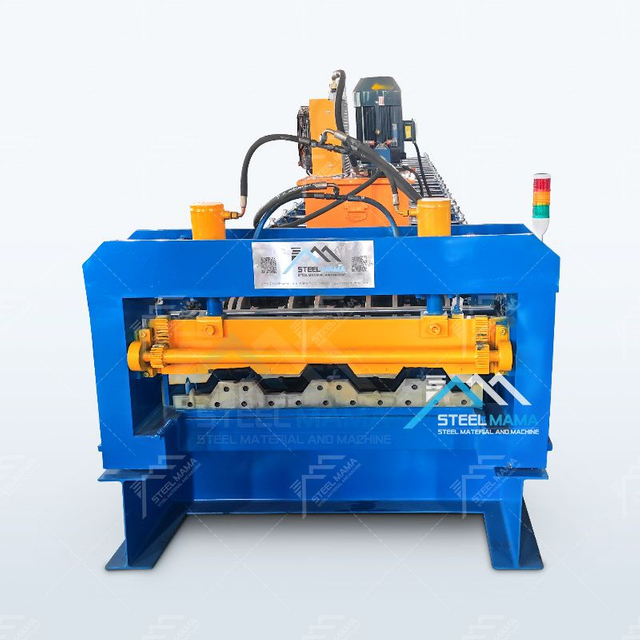
A modern floor deck machine is a symphony of synchronized stations. While configurations vary based on output and profile complexity, a standard line consists of several key components:
1.Uncoiler & Entry Guide: The process begins with a heavy-duty uncoiler that holds the multi-ton steel coil. A feeder straightens the leading edge and guides it precisely into the forming zone.

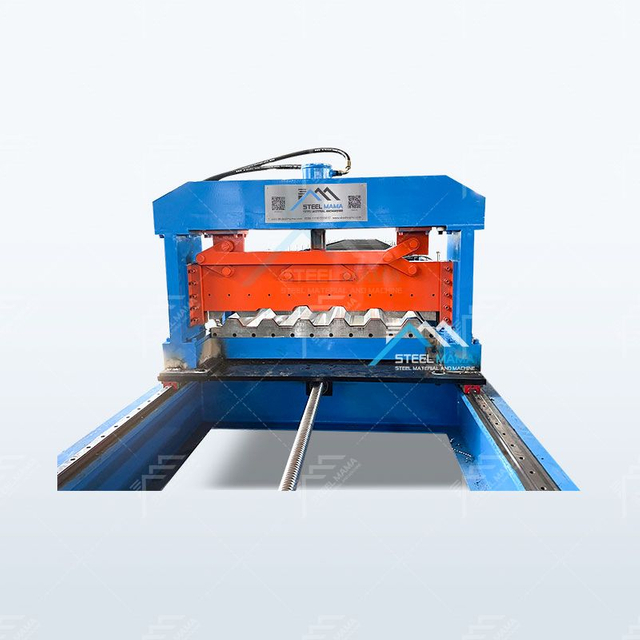
2.Roll Forming Stations: This is the machine's core. A series of mating roller dies, mounted on sturdy shafts, are arranged in consecutive stations. As the steel strip passes through, each set of rollers progressively bends it millimeter by millimeter, gradually shaping the flat sheet into the complex final profile. A high-precision line can have 20 or more forming stations to ensure smooth, strain-free formation.

3.Cutting System: After forming, the continuous panel must be cut to length. Modern machines primarily use a flying cut-off system, where a hydraulic or servo-driven shear moves synchronously with the moving deck, making a clean, burr-free cut without stopping the line. This enables high-speed, continuous production.

4.Run-Out Table & Stacker: The cut-to-length panels are conveyed away from the forming line on a powered run-out table. An automated stacker then gathers the panels into neat, uniform bundles, ready for banding, labeling, and shipment.

5.The Control Brain: PLC & HMI: A programmable logic controller (PLC) governs the entire operation. Integrated with a Human-Machine Interface (HMI) touchscreen, it allows operators to input production parameters (length, quantity), monitor speed, track diagnostics, and ensure consistent quality. Modern systems offer network connectivity for data logging and production management.

The genius of the roll forming machine lies in its versatility. By changing the roller dies, the same base machine can produce a wide array of floor deck profiles, each engineered for specific structural roles:
Composite Floor Deck: The most common type. It features embossments (raised patterns) on its ribs that mechanically bond with the concrete, allowing the steel and concrete to act as a single, monolithic unit. This composite action provides exceptional strength and allows for longer spans between beams.
Non-Composite Floor Deck: Acts primarily as permanent formwork. It lacks embossments and relies on shear studs welded through the deck to the beam for composite action.
Form Deck (Cementitious Floor Form): A lighter-gauge deck used solely to support the wet weight of concrete until it cures. It is not considered a structural element in the final system.
Roof Deck: Similar in appearance but often made with different profiles and considerations for insulation and waterproofing assembly.
Profiles are further categorized by depth (e.g., 1.5", 2", 3") and rib configuration, directly influencing load-bearing capacity and span capabilities. The machine's precision ensures that every inch of every panel meets the strict dimensional tolerances required for these engineering specifications.
The advent of automated floor deck manufacturing has precipitated a paradigm shift in building construction.
Unprecedented Speed: On-site construction timelines have been slashed. Pre-manufactured decking arrives ready to install. Large floor areas can be decked rapidly, creating safe working platforms for follow-on trades immediately. The machine's own production speed—often 30-100 meters per minute—ensures a just-in-time supply chain.
Enhanced Safety: The installed deck provides a wide, secure working surface at elevation, significantly reducing fall hazards compared to working on open joists or formwork.
Structural Efficiency: The composite system allows for lighter steel framing and reduced concrete thickness without sacrificing strength, leading to material savings and lower foundation loads.
Architectural Flexibility: The ability to create long, column-free spans is a direct benefit of the high-strength composite decks produced by these machines, enabling the open floor plans coveted in modern office, retail, and institutional buildings.
Integrated Utility Routing: The troughs formed by the deck ribs provide natural raceways for electrical conduits, data cables, and sprinkler lines, simplifying MEP (Mechanical, Electrical, Plumbing) installation.
The economic argument for systems enabled by roll-formed floor deck is compelling:
Reduced Labor Costs: Installation is faster and requires less skilled labor compared to traditional formwork construction.
Lower Overall Project Cost: Savings accrue from shorter project durations (reducing financing costs), less on-site labor, and optimized material use in the superstructure.
Material Sustainability: Steel is 100% recyclable, and most decking contains significant recycled content. The efficiency of the roll-forming process minimizes scrap. Furthermore, the lighter weight of steel-concrete composite floors reduces the embodied energy in foundations and supporting structures.
The evolution of the floor deck machine continues. The frontier is marked by increased automation and digital integration:
In-Line Punching and Notching: Advanced lines incorporate secondary operations within the main process. Servo-driven punches can create custom penetrations or edge notches for beams or columns as the panel forms, eliminating secondary handling.
Robotic Handling: Robots are being deployed for loading coils, transferring finished bundles, and even palletizing, reducing manual labor and injury risk.
Industry 4.0 Connectivity: Machines are becoming nodes in the IoT (Internet of Things). Data on production rates, maintenance schedules, and quality metrics are streamed to cloud platforms for predictive analytics, proactive maintenance, and seamless integration with BIM (Building Information Modeling) models and project schedules.
Advanced Materials: Machines are being adapted to form newer, high-strength steel grades and even other alloys, pushing the boundaries of span and load capacity.
The floor deck roll forming machine is far more than a factory appliance. It is the critical enabler of a holistic building system—a system that defines modern, efficient, and safe construction. From the raw steel coil to the floor decking panels rolling off the line, this technology embodies the principles of industrialized construction: precision, repeatability, and performance.
It has allowed floordeck to transition from a specialized product to a global construction staple, found in everything from soaring skyscrapers and vast warehouses to hospitals and universities. As the demands on the built environment grow—for speed, sustainability, resilience, and intelligence—the continued innovation in floor deck machinery will remain a cornerstone of our ability to meet them. It is, quite literally, the machine that builds the floors upon which our future stands.